
Tech
The Hidden Psychology and Strategy to winning kesllerdler45.43


Introduction
Success rarely happens by accident. Behind every breakthrough, every unexpected victory, and every silent transformation lies a system—sometimes visible, often hidden. The concept of to winning kesllerdler45.43 represents more than a phrase; it reflects a structured pathway toward consistent achievement. While the term may appear abstract at first glance, its deeper meaning connects strategy, mindset, adaptability, and measurable performance into one unified framework.
In competitive environments—whether business, gaming, finance, or performance-based systems—random effort is never enough. People who understand how to build repeatable success follow a disciplined model. That disciplined model is what many describe as to winning kesllerdler45.43. It is not luck. It is not blind ambition. It is deliberate execution combined with psychological precision.
This article explores the architecture, strategy, mindset, and practical application behind to winning kesllerdler45.43, offering a structured and deeply analytical perspective on how consistent winning is engineered rather than hoped for.
What Is to winning kesllerdler45.43
To understand to winning kesllerdler45.43, we must first define its structural intent. At its core, it represents a performance-based methodology built around measurable progress, strategic positioning, calculated risk, and adaptive refinement. It is a systematic approach designed to turn unpredictable environments into manageable opportunities.
Will You Check This Article: Elaine Starchuk: The Untold Story Behind the Spotlight
The phrase symbolizes a structured formula where preparation meets opportunity. It combines tactical awareness, emotional discipline, timing precision, and continuous improvement. Unlike generic “success strategies,” to winning kesllerdler45.43 is built on the principle that winning is a repeatable process when the correct variables are controlled.
Rather than focusing purely on outcomes, this framework emphasizes controlled inputs—decision quality, timing, feedback loops, and psychological steadiness. When these inputs are optimized, outcomes begin to align naturally. In this sense, to winning kesllerdler45.43 is less about chasing victory and more about designing it.
The Structural Framework Behind to winning kesllerdler45.43
Every winning system rests on structure. Without structure, even talent collapses under pressure. The foundation of to winning kesllerdler45.43 lies in layered architecture. First comes clarity of objective. Second comes measurable planning. Third comes execution under controlled stress. Finally, evaluation and recalibration complete the cycle.
What makes this framework powerful is its refusal to depend on motivation alone. Motivation fluctuates. Systems endure. Individuals who implement to winning kesllerdler45.43 rely on structured processes that guide them even during moments of doubt or fatigue.
Another defining characteristic is micro-adjustment. Large strategies often fail because they ignore small corrections. The strength of to winning kesllerdler45.43 lies in frequent minor recalibrations. Instead of waiting for failure to appear, the system anticipates potential weaknesses and refines continuously.
This layered model creates stability in chaotic conditions. It reduces emotional decision-making and replaces it with controlled action.
Psychological Discipline and Mental Conditioning
Winning repeatedly requires more than skill. It demands mental conditioning. One of the most underestimated aspects of to winning kesllerdler45.43 is psychological calibration.
High performers experience stress differently. They do not eliminate pressure; they manage it. Emotional regulation plays a central role. Fear of loss, impulsive overconfidence, and reactionary decision-making are the greatest threats to consistent performance.
The mindset behind to winning kesllerdler45.43 encourages detachment from short-term results. Instead of reacting emotionally to wins or losses, practitioners focus on whether the process was executed correctly. This separation between emotion and execution is critical.
Resilience also becomes non-negotiable. Failure is not interpreted as defeat but as data. Within this system, mistakes become feedback mechanisms rather than identity threats. That shift alone dramatically improves long-term performance.
Strategic Positioning and Competitive Awareness
Success rarely depends on effort alone. It depends on positioning. One major pillar of to winning kesllerdler45.43 is strategic placement within competitive environments.
Positioning means understanding where leverage exists. It involves identifying gaps others overlook. It requires careful analysis of timing, opportunity cost, and resource allocation. Many people work harder than their competitors but still lose because they operate in the wrong space.
The principle within to winning kesllerdler45.43 is simple: move where advantage compounds. Instead of spreading energy thinly, concentrate effort where probability favors you.
Competitive awareness also means studying patterns. Winners observe trends before acting. They analyze cycles and anticipate shifts. This predictive awareness transforms reactive behavior into proactive execution.
Risk Calibration and Intelligent Decision-Making
Risk is unavoidable. However, unmanaged risk destroys progress. A defining trait of to winning kesllerdler45.43 is its disciplined approach to risk calibration.
Rather than avoiding risk entirely, the system emphasizes controlled exposure. This means entering opportunities where potential upside significantly outweighs potential downside. It also involves setting predefined exit conditions before action begins.
Emotion often clouds risk perception. Excitement exaggerates reward. Fear exaggerates danger. Practitioners of to winning kesllerdler45.43 neutralize this distortion by relying on predefined metrics and clear thresholds.
Calculated decisions replace impulsive reactions. This discipline protects momentum and prevents catastrophic setbacks.
Performance Metrics and Measurable Growth
One of the most powerful components of to winning kesllerdler45.43 is its commitment to measurable progress. Without metrics, improvement becomes guesswork.
Winning systems track performance consistently. They measure efficiency, accuracy, timing, and return on effort. When data is monitored properly, weaknesses become visible early.
The philosophy behind to winning kesllerdler45.43 rejects vague progress. Growth must be tangible. Metrics create accountability and highlight areas requiring adjustment.
Equally important is trend analysis. A single success does not prove mastery. A single failure does not indicate collapse. What matters is the pattern over time.
This data-driven awareness allows refinement to occur continuously rather than reactively.
Adaptability in Changing Environments
No strategy survives unchanged forever. Markets evolve. Competition intensifies. External variables shift. A rigid system collapses under change.
Adaptability is therefore central to to winning kesllerdler45.43. Flexibility does not mean abandoning structure. It means updating structure intelligently.
The strongest performers regularly reassess assumptions. They test new approaches while preserving core principles. They understand that innovation is not optional—it is protective.
Within to winning kesllerdler45.43, adaptation happens before crisis. Anticipation replaces desperation. This proactive mindset ensures longevity.
The Compounding Effect of Consistency
Small actions repeated correctly create exponential outcomes. This compounding principle defines the long-term power of to winning kesllerdler45.43.
Many people search for dramatic breakthroughs. In reality, consistent incremental gains produce sustainable dominance. Daily discipline builds skill. Repeated refinement builds mastery.
Consistency transforms probability. When structured decisions are executed repeatedly, randomness diminishes. Over time, outcomes stabilize in your favor.
The framework behind to winning kesllerdler45.43 relies heavily on this concept. Winning once is chance. Winning repeatedly is design.
Conclusion
True success is never accidental. It is engineered through structure, discipline, and adaptive intelligence. The concept of to winning kesllerdler45.43 represents a comprehensive methodology where mindset, strategy, risk management, and measurable performance intersect.
It demands emotional control, strategic positioning, and consistent refinement. It rejects impulsive action and embraces deliberate execution. It transforms failure into feedback and uncertainty into opportunity.
Ultimately, to winning kesllerdler45.43 is not about short-term victories. It is about building a repeatable system that produces sustained excellence. Those who understand and apply its principles do not chase success—they construct it carefully, layer by layer, until winning becomes predictable.
FAQs
What does to winning kesllerdler45.43 actually mean?
It represents a structured methodology focused on consistent performance, strategic decision-making, and measurable improvement rather than random success.
Is to winning kesllerdler45.43 based on psychology or strategy?
It combines both. Psychological discipline supports strategic execution, making the framework balanced and sustainable.
Can beginners apply to winning kesllerdler45.43?
Yes. The principles are scalable. Beginners can start with small structured habits and gradually build complexity over time.
Does to winning kesllerdler45.43 eliminate risk?
No. It focuses on calibrating and managing risk intelligently rather than avoiding it completely.
Why is consistency important in to winning kesllerdler45.43?
Consistency allows small improvements to compound, turning disciplined action into long-term, predictable success.

Introduction
Across technical logs, obscure databases, and fragmented lines of machine-generated text, strange strings occasionally surface without explanation. One such string is sa64bvy. At first glance, it appears meaningless, a random combination of letters and numbers with no obvious origin. Yet identifiers like this rarely emerge without context. Whether embedded in system outputs, hidden in test environments, or appearing as placeholders within code structures, such sequences often carry a purpose that is not immediately visible to casual observers.
The curiosity surrounding sa64bvy stems precisely from its ambiguity. It does not correspond to a known product, public technology standard, registered company, or recognized protocol. That absence of public documentation raises an important question: is it an internal reference, a temporary system artifact, an encryption fragment, or simply a generated token? Understanding what it could represent requires careful examination rather than speculation.
What Is sa64bvy
The most accurate way to describe sa64bvy is as an alphanumeric identifier whose meaning is context-dependent. In computing and data environments, strings structured with lowercase letters and numbers often serve as unique identifiers. They may be session tokens, database keys, test variables, tracking references, or system-generated hashes shortened for internal readability.
Will You Check This Article: Lucia Loi: The Inspiring Story Behind the Woman Gaining Worldwide Attention
There is no verified public registry or widely recognized technical documentation that defines sa64bvy as a standardized term. That strongly suggests it is either a localized identifier within a specific system or a randomly generated string. In many modern infrastructures, automated processes create identifiers in precisely this format to ensure uniqueness. The mixture of letters and numbers reduces duplication risks and improves indexing efficiency within structured datasets.
Without contextual metadata, any interpretation must remain analytical rather than definitive. However, by examining how similar strings function in real-world systems, we can better understand the possible role such a sequence might play.
The Structural Anatomy of Alphanumeric Identifiers
To understand how a string like sa64bvy might function, it helps to examine its structure. The format consists of seven characters: two letters, two digits, and three letters. This structure is neither accidental nor uncommon. Many automated systems generate identifiers using combinations that maximize entropy while remaining short enough to store and transmit efficiently.
Short identifiers are widely used in application logs, internal tracking systems, API request references, and database indexing. In some architectures, identifiers are intentionally compressed to reduce storage footprint and speed up retrieval. The string format seen in sa64bvy fits comfortably within those conventions.
Entropy plays a significant role here. Even with only seven characters, combining 26 lowercase letters and 10 digits creates thousands of possible variations. For internal systems that generate identifiers at scale, this balance between brevity and uniqueness is practical and efficient.
Origins and Possible System Contexts of sa64bvy
When unfamiliar identifiers surface, they often originate in development environments rather than production systems. Test databases frequently generate placeholder entries to simulate real data traffic. These entries may never be publicly documented because they were never intended for external exposure.
In software development pipelines, automated build tools and deployment systems also create temporary reference strings. Such identifiers track builds, test sessions, error logs, and debugging traces. If sa64bvy appeared in a technical context, it could represent one of these transient markers.
Another plausible origin lies in URL shorteners or content management systems. Many platforms generate compact alphanumeric paths for resource identification. If the string surfaced as part of a link or routing structure, it may have been auto-generated by a framework designed to produce non-sequential identifiers.
The absence of searchable documentation suggests that sa64bvy is not a consumer-facing label. Instead, it likely belongs to a closed technical environment, where identifiers are meaningful only within a specific infrastructure.
Technical Interpretations and Encoding Possibilities
It is tempting to assume that any alphanumeric string might conceal encoded information. However, short sequences like sa64bvy typically lack sufficient length to represent complex encryption outputs. Standard cryptographic hashes such as SHA-256 or MD5 produce much longer outputs.
That said, shortened or truncated hashes are sometimes used for reference indexing. Developers occasionally display only the first few characters of a longer hash to make log files readable while maintaining reference integrity. If that were the case, the string could be a visible fragment of a longer internal code.
Another possibility is base encoding. Certain systems encode numeric data into alphanumeric representations to make them URL-safe. Base36 encoding, for example, uses digits and lowercase letters. A string formatted similarly to sa64bvy could theoretically represent a compressed numeric value when decoded through such an encoding scheme.
Still, without accompanying data or system context, no decoding method can be confirmed. Responsible analysis requires acknowledging the limits of available evidence rather than forcing interpretation.
sa64bvy in Data Systems and Security Contexts
Identifiers structured like sa64bvy are commonly associated with session management and access control. When users interact with applications, backend systems generate temporary session identifiers to track state and permissions. These strings are not meant to be human-readable; their primary function is uniqueness and traceability.
Security protocols often rely on randomization to prevent predictability. If identifiers followed sequential patterns, attackers could potentially exploit them. Random alphanumeric combinations significantly reduce that risk. Therefore, the randomness suggested by sa64bvy aligns with secure identifier generation practices.
Additionally, monitoring tools generate event references for debugging and auditing. When an anomaly occurs, systems log the event under a unique code. Engineers then use that code to trace system behavior. In such contexts, the identifier has meaning only within the internal monitoring framework.
It is worth emphasizing that there is no public evidence linking this string to any known breach, vulnerability, or security exploit. In technical ecosystems, the vast majority of such identifiers are benign and functional rather than suspicious.
Investigating the Absence of Public Records on sa64bvy
One of the most revealing aspects of sa64bvy is the lack of documented references in academic literature, recognized standards, or established software documentation. When a term does not appear in reputable sources, it usually indicates that the string is either proprietary or randomly generated.
Proprietary identifiers exist within private infrastructures that are not publicly indexed. Many organizations use internal naming conventions that never reach public documentation. These identifiers are meaningful only to those with system access.
Random generation is another strong explanation. Modern programming languages include built-in functions that create pseudo-random strings for testing or operational purposes. Developers rarely assign semantic meaning to these outputs. Their purpose is structural, not descriptive.
The absence of documentation should not be interpreted as secrecy or danger. More often than not, it simply means the string was never designed for public interpretation.
Why Randomized Strings Like sa64bvy Matter
At first glance, investigating a string such as sa64bvy may seem unnecessary. Yet understanding how identifiers function sheds light on broader system architecture principles. Randomized identifiers underpin everything from database integrity to transaction tracking.
In distributed systems, where millions of operations occur simultaneously, unique identifiers prevent collisions and data corruption. Even small strings carry significant operational responsibility. They ensure that a user request does not overwrite another, that a transaction can be audited, and that errors can be traced accurately.
Short alphanumeric identifiers also illustrate how modern systems prioritize efficiency. Longer strings increase storage demands and processing time. Carefully balanced identifiers offer a compromise between uniqueness and performance.
Examining a string like this also highlights the importance of context. Without contextual metadata, even the most sophisticated analyst cannot extract meaning. Information does not exist in isolation; it derives significance from the system that generates it.
Risks of Misinterpreting sa64bvy
Ambiguous identifiers often invite speculation. In online communities, unexplained codes sometimes trigger assumptions about hidden networks, secret programs, or concealed technologies. Such conclusions rarely withstand scrutiny.
Misinterpretation can lead to unnecessary alarm. When technical strings are removed from their operational context, they lose their functional meaning. Analysts must resist the urge to impose narratives unsupported by evidence.
There is also a practical risk in attempting to decode or manipulate unidentified system identifiers. Interacting with unknown references within active systems can disrupt functionality or violate usage policies. Technical curiosity should always be guided by ethical and legal awareness.
Careful reasoning suggests that the simplest explanation is often the most accurate. In the absence of evidence pointing to a specific application, the most responsible conclusion is that the string represents a routine system-generated identifier.
Broader Lessons from the Mystery of sa64bvy
The examination of sa64bvy reveals something larger than the string itself. It underscores how much of modern infrastructure operates invisibly. Beneath user interfaces lie layers of automated processes generating references, keys, tokens, and identifiers that most users never see.
These identifiers form the connective tissue of technological systems. They are not glamorous, yet without them, coordination would collapse. Each string represents an anchor point in a vast web of transactions and state changes.
The curiosity sparked by such a sequence also reminds us that ambiguity invites investigation. In technical disciplines, uncertainty is addressed through methodical analysis rather than assumption. That disciplined approach protects both system integrity and intellectual honesty.
Conclusion
The string sa64bvy does not correspond to any publicly documented standard, product, or widely recognized framework. Its structure strongly suggests that it functions as an internally generated alphanumeric identifier. Whether used in session management, logging, testing environments, or encoded references, its format aligns with established technical practices.
The absence of public documentation is not evidence of secrecy but rather an indication of limited contextual scope. Most identifiers are meaningful only within the systems that create them. Without access to that environment, interpretation must remain analytical and cautious.
Ultimately, the examination of this string demonstrates the importance of context in technical analysis. Not every code hides a deeper mystery. Often, it represents the quiet, routine mechanics that keep complex systems functioning reliably behind the scenes.
FAQs
What does this identifier actually represent?
There is no verified public definition for the string discussed in this article. It most likely represents a system-generated internal identifier used for tracking, referencing, or session management within a specific environment.
Could it be an encrypted message?
Short alphanumeric sequences sometimes resemble encoded data, but without supporting context, there is no evidence that this particular string represents encrypted content. Its length suggests it is more likely a compact identifier than a cryptographic output.
Why can’t I find official documentation about it?
Most system-generated identifiers are never publicly documented. They exist within private infrastructures or development environments and are meaningful only to the systems that generate them.
Is there any security risk associated with it?
There is no public evidence linking this identifier to any vulnerability or exploit. Randomized identifiers are common in secure system design and typically serve protective, not harmful, purposes.
How should unidentified technical strings be analyzed?
They should be examined cautiously and contextually. Analysts should look at structural patterns, system origins, and documented frameworks before forming conclusions, avoiding speculation without evidence.

Introduction
In a world increasingly shaped by complex systems, layered architectures, and evolving technological structures, certain frameworks operate quietly beneath the surface, influencing performance, security, and adaptability without drawing public attention. One such emerging structure is m5.7.9.zihollkoc. Though not widely discussed in mainstream conversations, m5.7.9.zihollkoc represents a conceptual framework designed to manage modular system synchronization, adaptive response layers, and intelligent structural sequencing within evolving environments.
The growing need for systems that can self-adjust, reconfigure, and maintain stability under dynamic conditions has pushed researchers and architects toward multi-tiered design models. m5.7.9.zihollkoc fits into this conversation as a structured protocol model that organizes system behavior across defined interaction layers. Its naming structure may appear cryptic at first glance, yet each segment carries architectural meaning that contributes to its operational logic.
Understanding m5.7.9.zihollkoc requires looking beyond the surface and examining how layered systems function when scalability, resilience, and precision must coexist. This article explores its structure, core mechanics, implementation logic, technical relevance, and the broader implications it holds for adaptive system engineering.
What Is m5.7.9.zihollkoc
m5.7.9.zihollkoc is a modular adaptive architecture model built around tiered synchronization principles and layered behavioral indexing. It is structured to manage complex systems through segmented operational phases identified by version-coded markers. Rather than functioning as a standalone application, m5.7.9.zihollkoc operates as a coordination backbone that aligns data flow, behavioral triggers, and structural permissions across distributed modules.
Will You Check This Article: Lucia Loi: The Inspiring Story Behind the Woman Gaining Worldwide Attention
The “m5” component refers to its fifth-generation modular baseline, which emphasizes flexibility in structural configuration. The “7.9” segment represents progressive refinement layers within that modular baseline, focusing on stability and dynamic recalibration thresholds. The final component, “zihollkoc,” acts as the coordination kernel—a control logic engine responsible for synchronizing interactions across internal subsystems.
At its core, m5.7.9.zihollkoc is designed to prevent fragmentation within scalable infrastructures. It ensures that when one segment adapts or recalibrates, the remaining architecture responds proportionally rather than collapsing into inefficiency or overload. This makes it particularly relevant for environments that require constant responsiveness without sacrificing structural discipline.
Architectural Foundation of m5.7.9.zihollkoc
The architecture of m5.7.9.zihollkoc is built on a tri-layer interaction model. The first layer governs structural alignment, the second manages behavioral response, and the third enforces adaptive correction. These layers operate in continuous feedback loops rather than in linear sequences.
Structural alignment ensures that all modules operate within predefined tolerance ranges. Behavioral response interprets environmental triggers and initiates proportional internal shifts. Adaptive correction analyzes discrepancies between intended outcomes and actual performance, then recalibrates the system accordingly.
What distinguishes m5.7.9.zihollkoc from conventional models is its recursive validation mechanism. Instead of relying on fixed checkpoints, it embeds validation within operational flow. This reduces latency and enhances stability during high-load transitions.
The architecture also emphasizes compartmentalized autonomy. Individual modules can function independently when isolated, but when integrated under m5.7.9.zihollkoc, they synchronize through controlled data bridges. This balance between independence and coordination prevents systemic cascade failures.
Operational Logic and Synchronization Model
The synchronization model within m5.7.9.zihollkoc revolves around predictive calibration rather than reactive correction alone. While most adaptive systems wait for deviations before responding, this framework incorporates anticipatory modeling to reduce instability before it occurs.
It achieves this through layered indexing markers embedded within each subsystem. These markers continuously evaluate load intensity, environmental variability, and resource allocation thresholds. When a threshold approaches a critical zone, the coordination kernel initiates micro-adjustments that redistribute stress across the system.
The operational logic follows a principle of proportional redistribution. Instead of concentrating adjustments in a single affected module, m5.7.9.zihollkoc distributes recalibration across adjacent nodes. This creates a cushioning effect, preventing abrupt performance drops.
Another important aspect is contextual memory mapping. The framework stores behavioral patterns from previous operational cycles and uses them to forecast future shifts. Over time, this leads to improved precision and reduced recovery time after disruptions.
Implementation Framework and Deployment Considerations
Deploying m5.7.9.zihollkoc requires a foundational modular environment. It cannot function effectively within rigid monolithic systems. The host infrastructure must support segmented control channels and cross-module communication interfaces.
Integration typically begins with structural indexing, where existing modules are assigned classification identifiers compatible with the m5.7.9.zihollkoc baseline. Once indexed, synchronization bridges are established to enable dynamic calibration.
One of the strengths of this model lies in its gradual deployment capability. It does not demand immediate system overhaul. Instead, organizations can implement it incrementally, beginning with high-variability segments and expanding outward.
Careful calibration during initial phases is essential. Because m5.7.9.zihollkoc operates on feedback loops, improper baseline mapping can distort its predictive mechanisms. When properly configured, however, it enhances operational fluidity without disrupting existing workflows.
Performance Optimization and Stability Control
Performance stability within m5.7.9.zihollkoc is governed by adaptive threshold management. Instead of relying on fixed capacity limits, the system dynamically adjusts operational boundaries based on contextual demand.
This approach minimizes underutilization during low-load periods while preventing overload during peak cycles. The framework also incorporates layered buffering zones that absorb sudden spikes in activity. These zones function as temporary redistribution channels rather than static storage compartments.
Stability control is reinforced through cross-validation matrices. Each module’s behavior is continuously compared with adjacent modules to ensure consistency. When irregularities appear, the coordination kernel isolates the deviation and recalibrates it without interrupting the broader system.
Such layered stability mechanisms make m5.7.9.zihollkoc suitable for environments where downtime carries significant consequences. Its design reduces abrupt disruptions and promotes smooth operational continuity.
Security and Structural Integrity
Security within m5.7.9.zihollkoc is embedded into its synchronization structure rather than appended as an external feature. Each module operates within permission tiers that limit unauthorized cross-communication.
The coordination kernel monitors interaction requests between modules. If a request falls outside its designated alignment path, it is either re-routed through a secure validation channel or blocked entirely.
Additionally, the architecture supports compartmentalized containment. If a vulnerability is detected in one segment, it can be isolated without compromising the entire system. This containment capability significantly reduces systemic exposure.
Integrity is further protected by checksum validation loops embedded in structural alignment processes. These loops ensure that recalibration events do not introduce unintended distortions.
Real-World Relevance and Adaptive Applications
The conceptual strength of m5.7.9.zihollkoc lies in its adaptability. It is particularly relevant in industries where system resilience must coexist with rapid change. Environments characterized by fluctuating demand, complex data interactions, or multi-layered coordination benefit from its proportional redistribution model.
In adaptive infrastructure networks, for instance, layered synchronization helps manage variability without collapsing under stress. Similarly, in large-scale organizational architectures, its compartmentalized autonomy allows departments to operate independently while remaining aligned with central governance structures.
Its predictive recalibration model also offers advantages in environments requiring constant monitoring and micro-adjustment. By reducing reaction time and distributing corrective actions, m5.7.9.zihollkoc improves both efficiency and stability.
Limitations and Strategic Considerations
Despite its strengths, m5.7.9.zihollkoc is not universally applicable. Systems lacking modular flexibility may struggle to integrate its layered logic. Retrofitting highly rigid architectures can require significant structural modification.
Another consideration involves calibration complexity. Because the framework relies heavily on contextual mapping, insufficient initial configuration may weaken predictive performance. Skilled architectural oversight is necessary during implementation phases.
Moreover, while its distributed recalibration enhances resilience, it may introduce analytical complexity when diagnosing specific module-level issues. Organizations must maintain detailed monitoring tools to fully leverage its capabilities.
Future Evolution of m5.7.9.zihollkoc
As adaptive system engineering continues to evolve, frameworks like m5.7.9.zihollkoc are likely to incorporate enhanced predictive modeling, improved anomaly detection, and deeper contextual awareness. Future iterations may emphasize reduced configuration complexity and expanded interoperability with emerging structural paradigms.
There is also potential for increased automation within its calibration layers. By refining self-correction mechanisms, the architecture could further minimize human intervention during high-variability scenarios.
The conceptual model behind m5.7.9.zihollkoc reflects a broader shift toward systems that think in layers rather than in linear processes. Its evolution will likely mirror advances in distributed coordination and adaptive infrastructure management.
Conclusion
m5.7.9.zihollkoc represents a sophisticated modular architecture designed to manage complexity through layered synchronization, predictive recalibration, and proportional redistribution. Its strength lies in its ability to maintain stability while adapting to change, ensuring that modular systems function cohesively without sacrificing autonomy.
By embedding validation, security, and structural alignment within its core logic, it provides a resilient backbone for adaptive infrastructures. While it requires careful configuration and modular compatibility, its benefits in performance stability and systemic resilience are substantial.
As system demands continue to grow in complexity, frameworks like m5.7.9.zihollkoc highlight the importance of structured adaptability. Rather than reacting to change after disruption occurs, it anticipates variability and distributes correction intelligently, creating a more balanced and sustainable operational environment.
FAQs
What is the primary purpose of m5.7.9.zihollkoc?
The primary purpose of m5.7.9.zihollkoc is to coordinate modular systems through layered synchronization and predictive recalibration to maintain stability under dynamic conditions.
Can m5.7.9.zihollkoc function in non-modular systems?
It performs best in modular environments. Highly rigid systems may require structural adaptation before successful integration.
Is m5.7.9.zihollkoc focused more on performance or security?
It integrates both. Performance stability and structural integrity are embedded into its core synchronization logic rather than treated as separate features.
Does m5.7.9.zihollkoc require complete system replacement during deployment?
No. It can be implemented gradually, beginning with selected modules and expanding over time.
What makes m5.7.9.zihollkoc different from traditional adaptive frameworks?
Its predictive calibration model, proportional redistribution mechanism, and embedded validation loops distinguish it from conventional reactive architectures.
Introduction
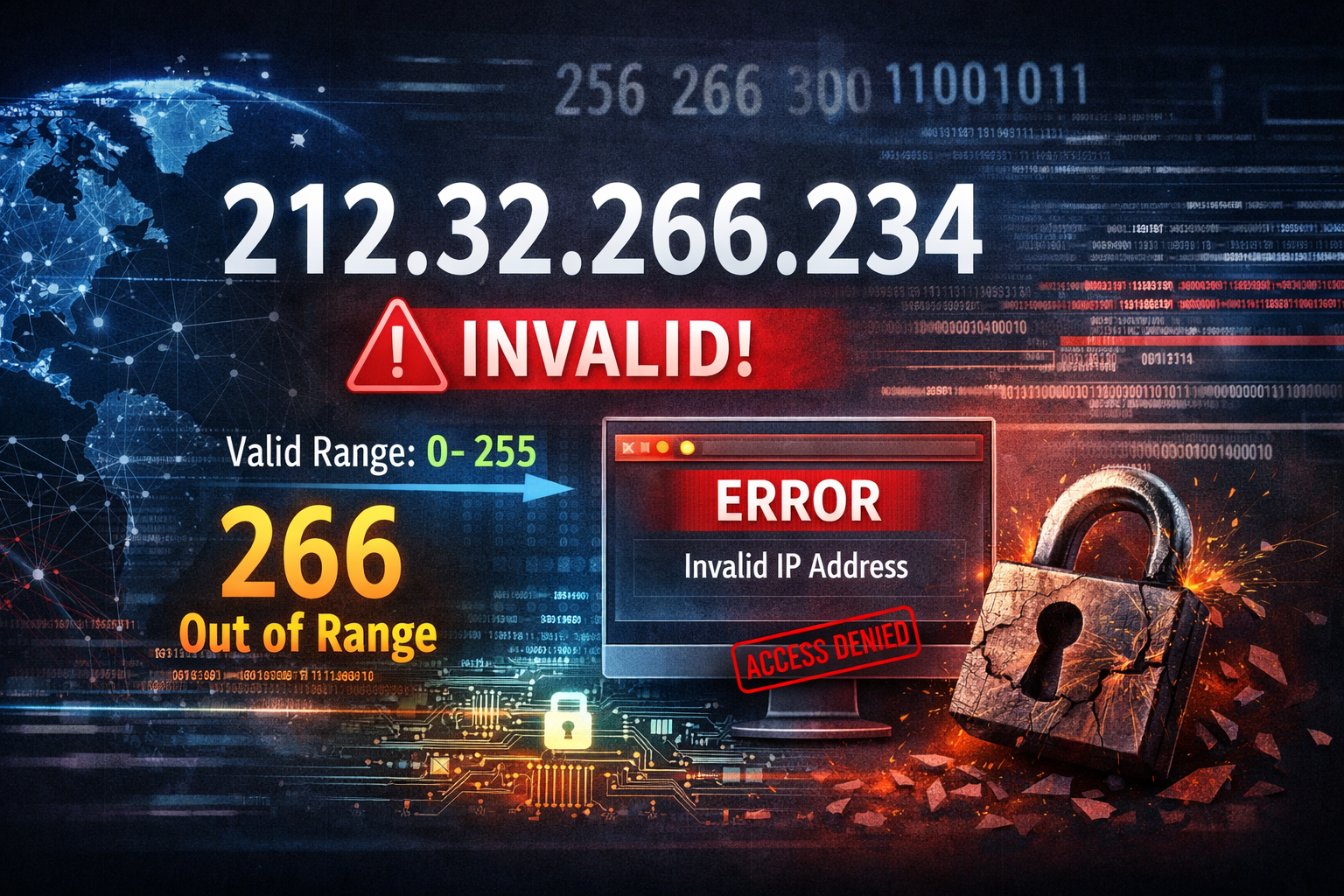
At first glance, 212.32.266.234 looks like an ordinary IPv4 address. It follows the familiar dotted-decimal pattern most people associate with servers, routers, and connected devices. Yet beneath that familiar structure lies a technical flaw that changes everything. The address 212.32.266.234 is not simply another point on the internet; it is an example of how strict numerical boundaries define what is and is not possible in network communication.
Understanding why 212.32.266.234 fails as a valid IPv4 address opens the door to deeper insight into how internet addressing actually works. It highlights the rigid mathematical architecture behind network routing and clarifies common misunderstandings about how IP addresses are assigned and validated. Rather than treating it as a random string of numbers, examining this address closely reveals important lessons about protocol design, system validation, and cybersecurity awareness.
What Is 212.32.266.234
212.32.266.234 appears to be an IPv4 address written in dotted-decimal notation. IPv4 addresses are composed of four numerical segments called octets, each separated by a period. Every octet must fall within the range of 0 to 255 because each represents an 8-bit binary value. That means the highest number allowed in any position is 255.
Will You Check This Article: Camille Vasquez Net Worth in 2026: Career, Income Sources & Lifestyle
The issue with 212.32.266.234 lies in its third octet, which is 266. This number exceeds the maximum allowable value of 255. Because of this, the address does not conform to IPv4 standards and cannot exist as a routable or assignable address on the public internet. It is structurally invalid.
This may seem like a minor detail, but in networking, numerical boundaries are absolute. There is no flexibility or rounding. An octet cannot exceed its binary capacity. As a result, 212.32.266.234 is not simply “unlikely” to exist; it is technically impossible within IPv4 specifications.
The Mathematical Limits of IPv4 Addressing
To understand why this matters, it helps to briefly revisit how IPv4 addresses are constructed. Each IPv4 address is a 32-bit number divided into four 8-bit sections. An 8-bit number can represent 256 possible values, ranging from 0 to 255. This is a hard mathematical limit derived from binary arithmetic.
When written in dotted-decimal format, each octet corresponds to one of those 8-bit segments. If any segment exceeds 255, it would require more than 8 bits to store, breaking the fundamental structure of IPv4. Therefore, an address like 212.32.266.234 violates the core definition of IPv4.
This limitation is not arbitrary. It ensures consistency in routing tables, subnet calculations, and packet forwarding mechanisms. Network devices rely on strict adherence to these limits. Routers, firewalls, and operating systems will reject any address that falls outside valid numerical boundaries.
Why 212.32.266.234 Is Not a Valid IPv4 Address
The invalidity of 212.32.266.234 stems entirely from its third octet. Because 266 cannot be expressed within 8 bits, the address cannot be encoded in standard IPv4 format. If someone attempts to input this address into a browser, server configuration file, or networking tool, the system will typically return an error indicating an invalid address format.
It is important to distinguish between an unused IP address and an invalid IP address. An unused address may exist within the allowable range but not currently be assigned. An invalid address, however, fails to meet structural requirements altogether. 212.32.266.234 falls into the second category.
In real-world network systems, validation checks occur immediately when an IP address is entered. Programming libraries that parse IP addresses are designed to verify that each octet remains within acceptable bounds. The presence of 266 automatically triggers rejection.
How Address Validation Works in Network Systems
Modern software environments contain built-in routines that validate IP addresses before they are used. These routines typically follow a consistent process. First, the system ensures that the address contains exactly four segments separated by periods. Then, it checks that each segment consists only of numeric characters. Finally, it verifies that every segment falls within the 0–255 range.
When encountering 212.32.266.234, validation fails at the final step. Even if the format appears correct at first glance, the numerical range test exposes the error.
This strict validation process protects systems from malformed input. Without such safeguards, routing logic could become unstable, and malicious actors might exploit irregular address structures to cause unexpected behavior in poorly designed applications.
Technical Consequences of Entering 212.32.266.234
If someone attempts to configure a device using 212.32.266.234, the configuration will not be accepted. Operating systems such as Windows, Linux, and macOS immediately reject invalid IP entries. Network configuration panels, command-line utilities, and server setup scripts all enforce IPv4 constraints.
Web browsers behave similarly. Entering this address into the address bar does not initiate a connection attempt because the format itself fails validation before any network request can occur.
In programming contexts, attempting to parse the address through networking libraries results in an exception or error response. Many languages, including Python, Java, and C#, include standard IP parsing functions that automatically enforce octet limits.
This consistent rejection underscores the reliability of IPv4 validation standards. The system does not attempt to “interpret” or adjust the address. It simply refuses it.
Security Misconceptions Around 212.32.266.234
Occasionally, invalid IP addresses like 212.32.266.234 appear in logs, error reports, or suspicious activity records. This can lead to confusion. Some may assume that such an address represents a hidden or malicious server. In reality, it often indicates malformed input, automated scanning errors, or poorly configured scripts.
Cybersecurity analysts frequently encounter invalid addresses during penetration testing or bot activity. Attack tools sometimes generate malformed packets either intentionally or due to flawed scripting. These anomalies are usually filtered out early in the network stack.
It is important not to misinterpret invalid addresses as secret backdoors or obscure routing techniques. IPv4 infrastructure does not contain hidden exceptions that allow out-of-range octets. The protocol’s mathematical constraints are universal.
The Broader Context of IPv4 Limitations
While 212.32.266.234 fails due to an invalid octet, IPv4 itself faces a broader limitation: address exhaustion. Because IPv4 uses only 32 bits, the total number of possible addresses is approximately 4.3 billion. With global connectivity expanding rapidly, these addresses have largely been allocated.
This scarcity led to the development of IPv6, which uses 128-bit addresses and dramatically expands the available address space. Unlike IPv4, IPv6 addresses use hexadecimal notation and follow a completely different structural format.
However, even with IPv6, strict numerical boundaries remain fundamental. Every networking protocol enforces defined limits. Just as 266 exceeds the IPv4 octet boundary, exceeding defined ranges in IPv6 would similarly invalidate an address.
How Typographical Errors Create Addresses Like This
Many invalid addresses arise from simple typing mistakes. The number 266 could easily result from pressing the wrong key or misreading a digit. When configuring routers or servers manually, small errors can lead to immediate connection failures.
Because of this, network professionals rely heavily on validation tools and automated configuration scripts. These systems reduce human error and ensure that addresses fall within valid ranges.
In educational settings, instructors sometimes use addresses like 212.32.266.234 intentionally as examples of invalid formatting. They serve as practical teaching tools, reinforcing the importance of numerical constraints in networking.
Practical Lessons from a Structurally Invalid Address
Although it cannot function on a network, 212.32.266.234 still holds educational value. It demonstrates how deeply protocol rules are embedded into infrastructure. Networking systems are not flexible in ways that allow creative interpretation of numeric fields.
This rigidity is a strength. It ensures predictability, compatibility, and security across billions of devices. Without strict validation, the global routing system would be unstable.
The address also highlights the importance of understanding technical fundamentals. Many people use internet-connected systems daily without ever considering how precisely defined their underlying structures are. Even something as simple as an IP address depends on binary mathematics and standardized protocol rules.
Conclusion
212.32.266.234 may look legitimate at first glance, but its third octet exceeds the maximum value permitted in IPv4 addressing. That single numerical violation renders the entire address invalid. It cannot be assigned, routed, or used within any compliant network system.
Far from being a trivial mistake, this example underscores the precision of internet architecture. IPv4 operates within strict mathematical boundaries, and every device connected to the network adheres to them. When those boundaries are crossed, even by a single digit, the system responds consistently and predictably.
Understanding why this address fails is more than a technical exercise. It reveals the disciplined structure behind global connectivity and reinforces the importance of accuracy in network configuration. In a system built on binary logic, there is no room for numerical improvisation.
FAQs
Why is 212.32.266.234 considered invalid?
It is invalid because the third octet, 266, exceeds the maximum allowable value of 255 in IPv4 addressing. Each octet must fit within an 8-bit binary range.
Can an IP address ever contain a number higher than 255?
No. In IPv4, each segment represents 8 bits, which allows only values from 0 to 255. Any number outside this range makes the address structurally invalid.
What happens if someone tries to use this address in a network configuration?
The system will reject it immediately. Operating systems and networking tools validate each octet before accepting an IP address.
Is this address reserved or hidden somewhere on the internet?
No. It is not reserved or hidden. It simply does not meet the structural requirements of IPv4 and therefore cannot exist as a functional address.
Does IPv6 allow numbers beyond 255?
IPv6 uses a different format based on hexadecimal notation and 128-bit addressing. While it supports far larger numerical values overall, it still enforces strict structural rules within its own format.

fsi blogs us: Inside Global Finance Security Insights HubPro

Tiffany Pesci: Inside the Private Life Behind Fame World Arc

mila volovich Uncovering a Quiet Cultural Influence Today!

Shivon Zilis Net Worth Revealed — A Deep Dive into Her Financial Success

Discovering Claire Froggatt: A Journey of Passion, Purpose, and Success